
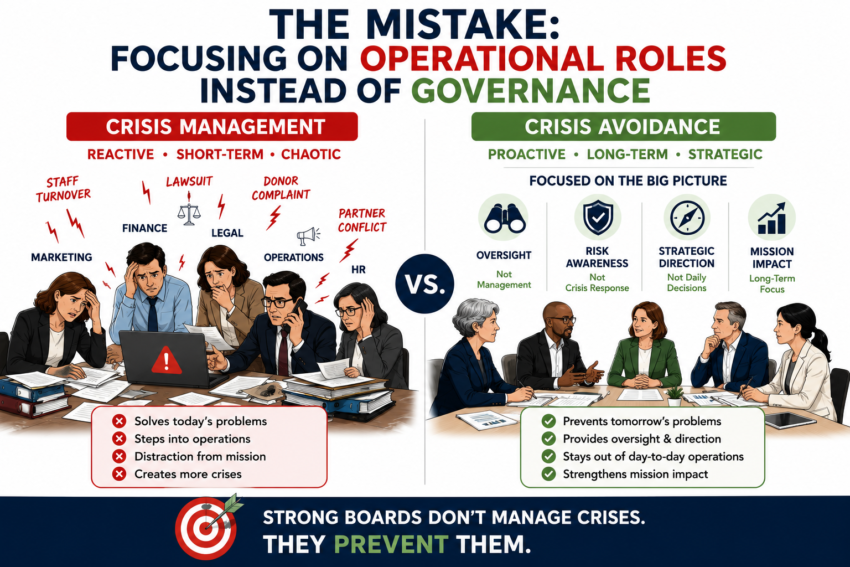
One of the biggest mistakes startup nonprofits make is recruiting people to run the organization rather than govern it.
Early boards often think:
“We need someone for marketing.”
“We need an accountant.”
“We need a lawyer.”
“We need an HR expert.”
It sounds logical.
In fact, it’s one of the most common recruiting mistakes I see.
A few years ago, I interviewed with a nonprofit seeking its next Executive Director. The position had experienced frequent turnover, but the board didn’t seem overly concerned.
In fact, they were proud of their board.
Every major business function was represented—marketing, finance, legal, HR, operations, and development. Whenever a problem arose, the board had an expert who could step in and fix it.
At first, that sounded like a strength.
It wasn’t.
Instead of governing the organization, the board became an extension of management.
Board members stepped into operational decisions.
Staff began waiting for board direction instead of leadership direction.
Priorities shifted from long-term strategy to short-term crisis management.
Employees became frustrated because decisions could change overnight depending on which board member became involved.
Eventually, turnover increased, relationships with partners deteriorated, and legal issues followed.
The board had incredible expertise.
It was simply being applied in the wrong place.
Because boards don’t manage departments.
They govern organizations.
That requires a very different skill set:
• Strategic thinking instead of tactical execution
• Oversight instead of management
• Accountability instead of activity
• Long-term direction instead of short-term crisis response
• Crisis avoidance instead of crisis management
Expertise is valuable.
A CFO can bring tremendous financial insight.
A marketing executive can ask excellent strategic questions.
An attorney can help identify governance risks.
But none of them should become the organization’s finance department, marketing department, or legal department from the boardroom.
Strong boards recruit people who can think beyond their profession.
People who understand governance.
People who strengthen decisions without taking over execution.
Because the purpose of a board is not to do the organization’s work.
It’s to ensure the organization is equipped, led, and accountable to do that work well.
If your board meetings regularly drift into operational problem-solving…
You may not have a meeting problem.
You may have recruited managers when what you really needed were governors.