
Recently, I was helping a nonprofit board recruit new board members. They had a detailed recruitment guide—more of a wish list for the perfect nonprofit superhero than a board member profile. It described the search process, interviews, and selection criteria.
Then it ended with one final step:
Offer accepted.
That’s when I realized something.
Like many nonprofit boards, they believed recruitment ends when someone says yes.
In reality, that’s when recruitment enters its most important phase.
The first 30 to 90 days are when a new board member decides—often subconsciously—whether they can truly make a difference.
Here’s what usually happens.
A new board member joins.
They’re excited.
They believe in the mission.
They want to contribute.
They’re ready to make an impact.
Then…
They’re handed a board packet.
Added to the next meeting.
Expected to figure everything else out.
No intentional onboarding.
No shared understanding of how the board actually functions.
No coaching.
No roadmap for success.
So they do what most people would do.
They watch.
They listen.
They try to “read the room.”
They become cautious.
And eventually, they adapt to whatever the board already is.
If the board has a healthy culture, they’ll grow into it.
If the board is disengaged, operational instead of strategic, or unclear about its role…
They’ll adopt those habits too.
Because onboarding doesn’t just transfer information.
It transfers culture.
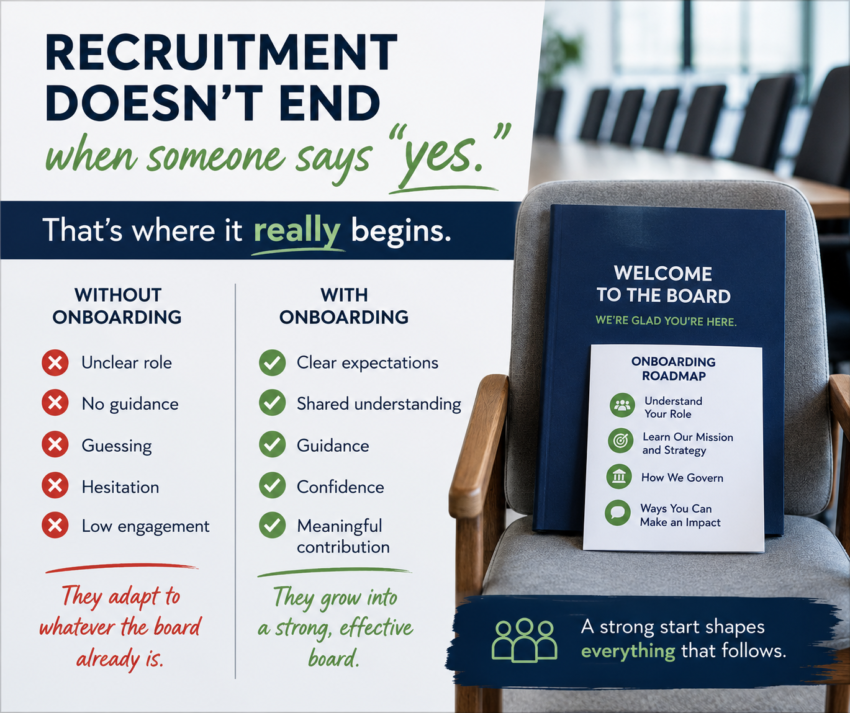
Without intentional onboarding, new board members are left to guess:
• What their role really is
• Where governance ends and operations begin
• How decisions are made
• What meaningful contribution looks like
• How they can make a difference
And guessing leads to:
• Hesitation
• Low engagement
• Inconsistent participation
• Quiet frustration
Not because they don’t care.
Because they were never set up to succeed.
Strong boards understand that onboarding is not separate from recruitment.
It is recruitment.
They:
• Set clear expectations from the beginning.
• Explain how the board governs—not just what it does.
• Clarify roles, responsibilities, and healthy boundaries.
• Coach new members through their first few meetings.
• Create early opportunities for meaningful contribution.
Because the goal isn’t simply to fill a seat.
It’s to help a new board member become a confident, engaged trustee.
If it takes a new board member six months to figure out how to contribute, that’s not a people problem.
It’s an onboarding problem.
Recruitment doesn’t end when someone says “yes.”
That’s where it really begins.