
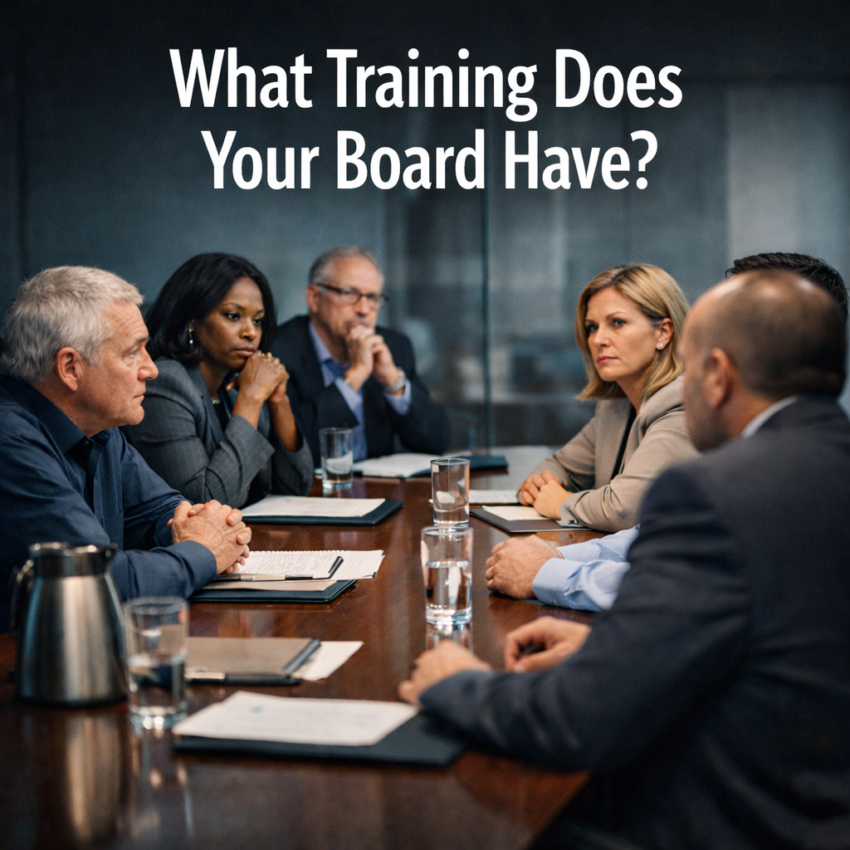
Years ago, I asked a nonprofit board one question during an Executive Director interview.
The room went completely silent.
I wasn’t trying to provoke anyone.
I was asking about governance.
The organization was well-known — but struggling.
The board had high expectations.
They made that clear.
Rapid-fire questions:
→ Staff turnover is high. How will you fix it?
→ Funding is down. Who can you bring to close the gap?
→ How much experience do you have?
→ Have you reported to a board before?
The tone was urgent.
Emotional.
Intense.
Near the end they asked:
“Do you have any questions for us?”
I did.
“What kind of board training do you provide for new members?
And what governance training do you do annually?”
Silence.
Blank stares.
Finally the board president said:
“We train on the job. We deal with situations as they arise.”
I paused.
“I’m not sure how I feel working for an untrained board,” I said carefully.
“Probably similar to how you’d feel hiring an untrained Executive Director.”
I wasn’t trying to be sharp.
Just honest.
Many boards expect a world-class Executive Director.
Few expect the same of themselves.
Boards expect professional leadership from their Executive Director.
But many boards don’t hold themselves to the same standard.
Governance is a discipline.
It can be learned.
And it must be learned.
Board training isn’t a luxury.
It’s risk management.
It’s culture formation.
It’s organizational stability.
I was offered the role — and I accepted.
For a time, things improved.
The board got better.
But culture is powerful.
Without deep alignment around the board’s role — governance, not management — the organization continued to struggle.
Eventually, we parted ways.
A trained board doesn’t guarantee success.
But an untrained one almost guarantees instability.
If we expect excellence from our Executive Directors, we should expect it from our boards too.
Quick question:
Does your board do formal governance training?
Yes / No / Not sure
Have you ever served on — or worked for — a board that lacked governance training?
What did it cost the organization?