
Some nonprofit boards unintentionally exclude their strongest future leaders.
Brian was helping lead a young, growing nonprofit.
He recruited volunteers.
Built partnerships.
Helped navigate the challenges that come with growth.
He had vision.
He understood nonprofit leadership.
He knew the difference between governance and management.
In many ways, he was exactly the type of person a board should want.
There was just one problem.
Brian wasn’t wealthy.
Like many nonprofit leaders, he spent his career serving a cause that could never pay him what he was worth.
When a board seat opened at another organization, his name came up.
But he was never seriously considered.
Not because he lacked leadership ability.
Not because he lacked governance experience.
Not because he lacked commitment.
Because he couldn’t meet the board’s annual giving expectation.
Brian wasn’t viewed as an asset because of his experience.
He was viewed as a liability because he could not give.
Sadly, some nonprofit boards don’t just encourage giving.
They require it.
A minimum contribution.
A “give or get” number.
A spoken or unspoken threshold that everyone understands.
The intent makes sense.
“We need committed people.”
“We need financial support.”
“We want people who have skin in the game.”
All reasonable.
But here’s the problem:
When the price of entry is high, the pool gets narrower.
Now you’re no longer asking:
“Who would be a strong board member?”
You’re asking:
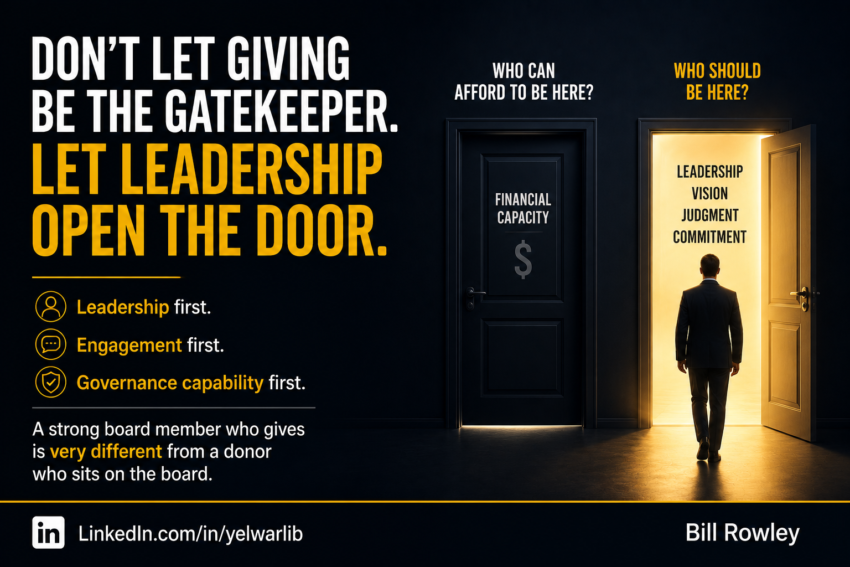
“Who can afford to be here?”
And those are not the same questions.
When giving becomes the gatekeeper, boards often get:
• Fewer perspectives
• Less diversity of thought and experience
• Members who are hesitant to challenge decisions
• Influence tied to dollars instead of contribution
And over time, something subtle happens.
The board shifts from governing…
…to preserving comfort.
Strong boards handle this differently.
They expect commitment.
Including financial commitment.
But they don’t let giving become the primary qualification for service.
They focus on:
• Leadership first
• Engagement first
• Governance capability first
And then align expectations around giving.
Because a strong board member who gives is very different from a donor who sits on the board.
The goal isn’t to build a board of people who can afford to be there.
It’s to build a board of people who need to be there.
If your board feels limited in perspective, engagement, or leadership…
It may not be a people problem.
It may be a barrier you’ve unintentionally created.