
(and pay for later)
When a capital campaign launches too soon, it’s rarely random.
There are patterns.
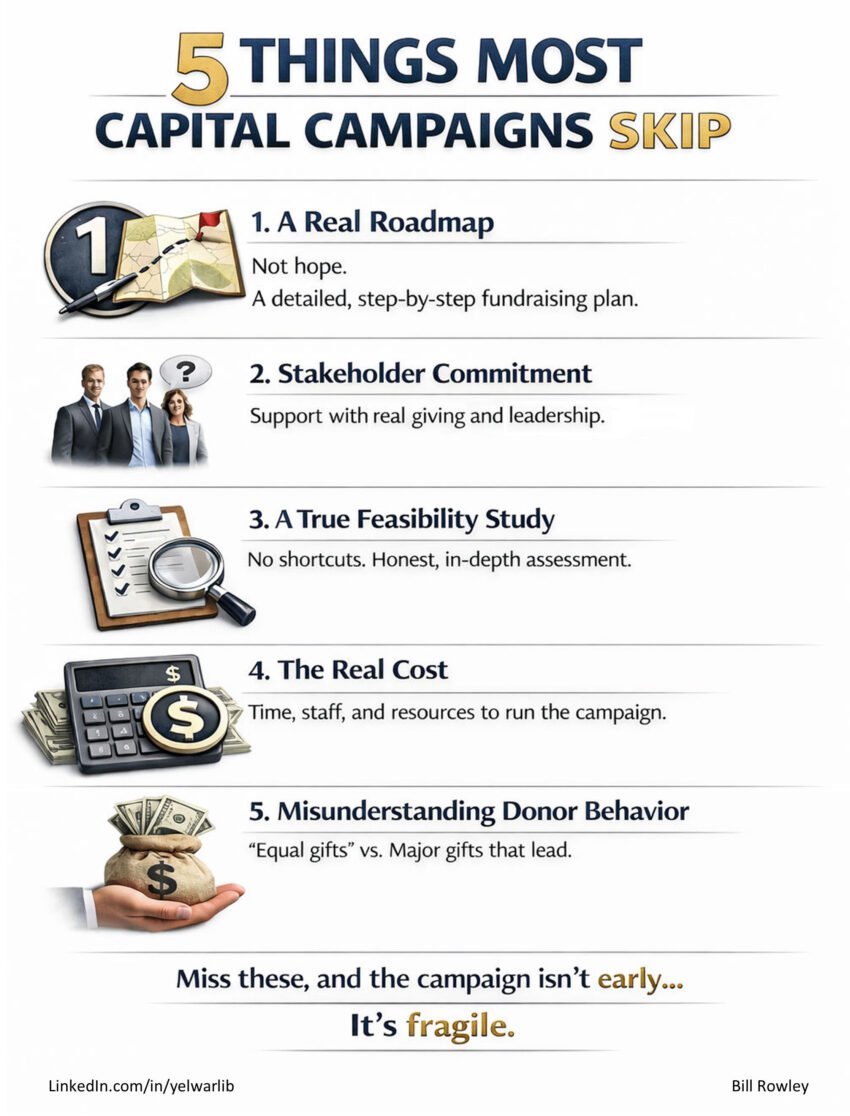
Here are 5 things I consistently see overlooked:
1) A real roadmap
Not hope. Not enthusiasm.
An actual plan for how funds will be raised.
Not in theory. In sequence.
It takes time.
2) Stakeholder commitment
People say they support the project…
…but haven’t committed to giving or leading.
Sometimes they don’t even know the project
just the need.
That gap matters.
3) A true feasibility study
This is where campaigns actually begin.
But too often:
→ The decision is already made before the study
→ The study doesn’t reflect the real project
→ Only a handful of voices are included
Instead of listening to the full ecosystem:
Board. Staff. Donors. Community.
Only a few are consulted
and they don’t have the capacity to fund the campaign.
4) The real cost of the campaign
Not just the project…
…but the time, people, systems, and effort required to raise the money.
A capital campaign is a new, short-term program.
5) A misunderstanding of donor behavior
One of the most common mistakes:
“Let’s divide the goal by the number of donors.”
That’s not how campaigns work.
Major gifts drive momentum.
Not equal giving.
None of these are small misses.
They’re structural.
And when they’re missing…
…the campaign isn’t early.
It’s fragile.
Next post: why nonprofits can still win big, when they do this right.